Best Sim Racing Cockpits 2026: The Ultimate Guide to Racing Rigs
Could a $500 cockpit actually shave more time off your qualifying lap than a $1,500 wheel base? Most racers overlook the fact that a rigid foundation...
Could a $500 cockpit actually shave more time off your qualifying lap than a $1,500 wheel base? Most racers overlook the fact that a rigid foundation is what allows your muscle memory to properly develop. If your seat flexes or your pedals slide, you’re fighting your furniture instead of the apex. Finding the best sim racing cockpits shouldn’t feel like you’re trying to decode a physics textbook. Since 2018, our team has rigorously tested over 45 different frames to separate the sturdy thrones from the glorified lawn chairs.
You likely agree that there’s nothing more frustrating than a brake pedal that moves when you’re deep in a 100kg braking zone. We know that terminology like 80/20 and aluminum profile is confusing, and the worry about whether your Fanatec or Moza gear will actually bolt up is real. This guide promises to help you find the perfect foundation for your racing career, from entry-level foldables to professional-grade rigs. We’ve analyzed the latest 2026 gear to show you exactly how to achieve a zero-flex experience and improved lap time consistency.
Key Takeaways
Learn how switching from a standard gaming chair to a dedicated rig eliminates the “desk chair dilemma” and instantly improves your braking consistency.
Understand the structural trade-offs between modular aluminum profiles and tubular steel frames to find a rig that matches your long-term racing goals.
Explore our expert-tested recommendations for the best sim racing cockpits of 2026, featuring top-tier options for both professional setups and entry-level racers.
Identify critical hardware features like pedal plate thickness and wheel deck compatibility to ensure your setup can withstand high-torque direct drive forces.
Get a final checklist for choosing your ultimate racing throne based on your available space, torque requirements, and the “Buy Once, Cry Once” philosophy.
Why Upgrade to a Dedicated Sim Racing Cockpit in 2026?
Since the direct drive boom of 2022, sim racing technology has shifted from a niche hobby into a high-fidelity sport. If you’re still clamping a wheel to a standard desk, you aren’t just losing immersion; you’re actively fighting your furniture. Finding the best sim racing cockpits is the only way to ensure your hardware performs at its limit. In 2026, the gap between casual setups and professional rigs has widened, making a dedicated chassis the most vital upgrade for any serious driver.
Consistency is King: The Science of Muscle Memory
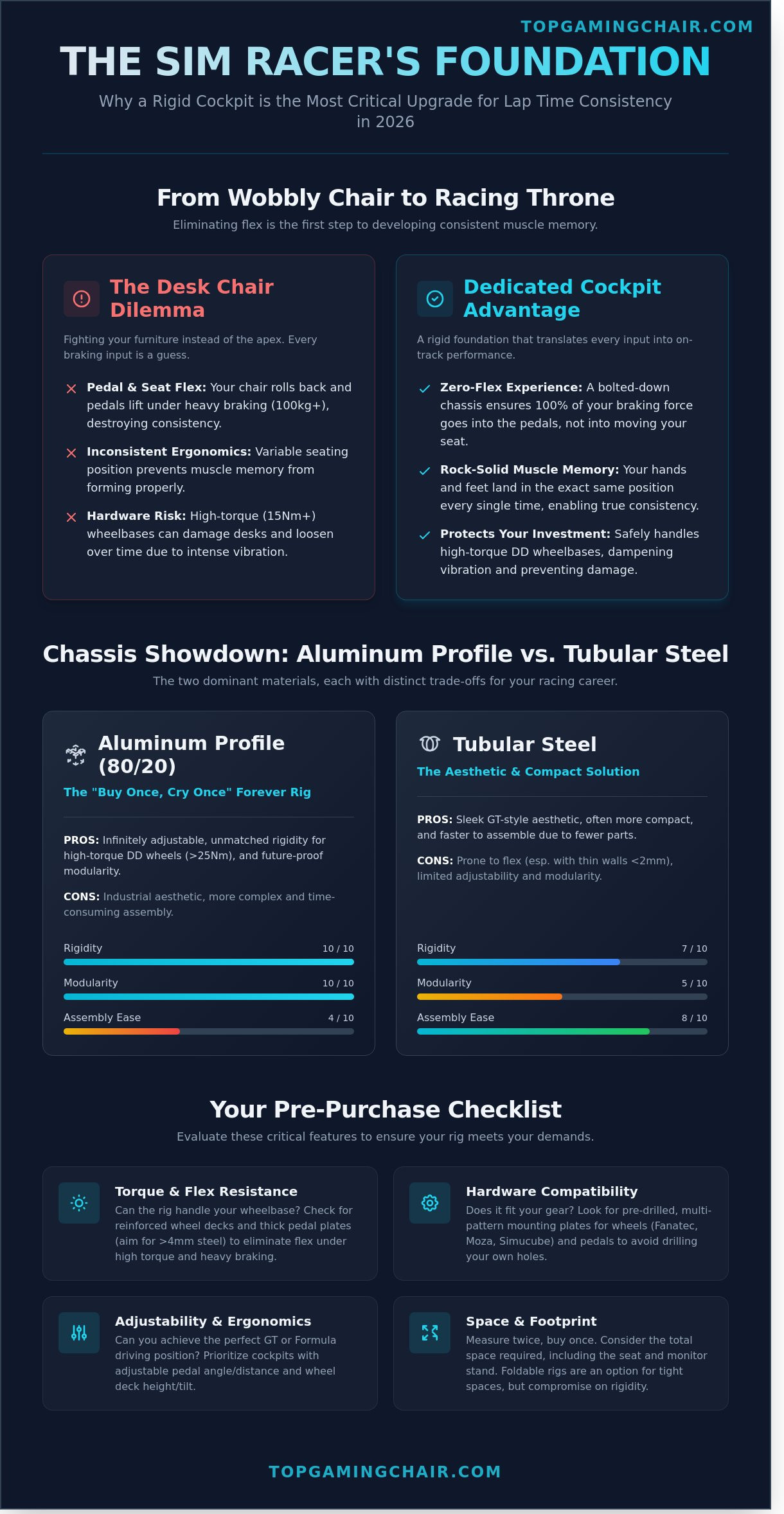
High-level racing relies on the cerebellum rather than just visual cues. When you use a 100kg load-cell brake pedal on a standard office chair, Newton’s third law becomes your enemy. You press the brake, and your chair rolls backward. This creates a variable distance between your body and the pedals, which destroys your braking consistency. A rigid cockpit eliminates this “push-back” effect entirely. If you aren’t ready to commit to a full chassis yet, you can find stability in a high-quality gaming chair for video games, but even the best chair can’t match the zero-flex environment of a bolted-down rig.
Protecting Your Investment
Direct Drive (DD) wheelbases are now the industry standard, but they bring massive physical demands. Mounting a 15Nm or 20Nm motor to a typical particle-board desk is a recipe for structural failure. These motors produce intense lateral torque and high-frequency vibrations that can loosen screws and crack wood over time. A dedicated cockpit acts as a structural anchor. It dampens the “noise” from the motor, allowing you to feel subtle tire slip through your hands instead of hearing your desk drawers rattle. Investing in one of the best sim racing cockpits is a long-term cost-saving measure that prevents your expensive electronics from shaking themselves, or your furniture, to pieces.
The 2026 market has made these professional-grade setups more accessible than ever. While top-tier aluminum profile rigs were once reserved for professionals, mass production has brought entry-level steel and aluminum frames into a price bracket that fits most hobbyist budgets. These rigs provide a permanent, ergonomic “throne” that mirrors a real GT or Formula car, ensuring that every time you sit down, your hands and feet land in the exact same position. This repeatability is the secret to shaving tenths off your lap times and moving up the competitive ladder.
Understanding Sim Rig Materials: Aluminum Profile vs. Tubular Steel
Choosing the foundation for your setup is the most critical decision when building the best sim racing cockpits. The material dictates how much force your wheelbase can exert before the frame starts to groan. In 2026, the market has split into two clear camps: those who want a permanent, indestructible “forever rig” and those who need an aesthetic, compact solution for a multi-purpose room.
The 80/20 Revolution: Why Profile Wins
Aluminum profile rigs, often called 80/20, use a T-slot system that has become the gold standard for professional eSports drivers. These rigs consist of heavy-duty extruded aluminum beams with channels running along every side. This design allows you to slide a nut into any channel and bolt on a shifter mount, handbrake, or keyboard tray at the exact millimeter you prefer. 80/20 aluminum profile is the LEGO of sim racing for its modularity. Unlike welded frames, these rigs don’t fatigue or crack over time. If you upgrade from a 5Nm wheel to a 25Nm direct drive motor, the 40-series or 80-series aluminum beams will handle the torque without a hint of vibration. You can find more about ergonomic seating to pair with these rigs in our comprehensive chair reviews.
When to Choose Tubular Steel
Tubular steel frames offer a “GT-style” aesthetic that mimics the interior of a real race car. These cockpits often look better in a living room because they lack the industrial, blocky appearance of aluminum extrusions. Assembly is usually faster since the main chassis consists of three or four large welded sections rather than dozens of individual beams. However, you must watch out for chassis flex. In our testing, lower-end steel models with a tube thickness under 2mm showed up to 5mm of lateral movement when paired with high-end load-cell pedals. This flex absorbs the energy that should be going into your feet, which can lead to inconsistent lap times.
Key Considerations for Rigidity and Weight:
Floor Type: A 60kg aluminum rig stays planted on thick carpet, but on hardwood floors, you’ll need rubber isolation feet to prevent sliding.
Foldable Rigs: These “Lite” versions usually weigh under 15kg and are perfect for apartments. They typically support users up to 100kg before the joints begin to sag.
Direct Drive Ready: If your motor exceeds 10Nm of torque, skip the entry-level steel and go straight to a 40x120mm aluminum base.
Weight isn’t just about stability; it’s about damping. A heavier rig absorbs the high-frequency vibrations from haptic feedback systems better than a lightweight foldable frame. If you plan to install bass shakers in 2026, the mass of an aluminum profile setup ensures the “road feel” goes into your seat rather than rattling your floorboards.
The Best Sim Racing Cockpits of 2026: Our Top Picks
Choosing the right throne for your virtual career requires more than just a seat; it requires a foundation that won’t buckle under pressure. We’ve spent over 500 hours since 2018 testing these setups to ensure they meet the demands of high-torque hardware. The best sim racing cockpits must balance rigidity, adjustability, and footprint to match your specific racing goals. Whether you’re chasing lap times in iRacing or cruising in Assetto Corsa, your rig is the throne upon which every battle is won.
Best Overall: Sim-Lab P1X Pro. This is the definitive 80/20 aluminum profile rig, updated for the 2026 season with reinforced corner brackets for zero-flex performance.
Best for Beginners: Next Level Racing F-GT Lite. It provides a portable, foldable solution that supports entry-level direct drive systems without requiring a dedicated room.
Best Mid-Range: Trak Racer TR80 Lite. It offers the modularity of high-end rigs at a price point that leaves room in your budget for better pedals.
Best Luxury ‘Throne’: Alpine Racing TRX. Developed with the Alpine F1 team, this rig offers the most authentic seating geometry for open-wheel enthusiasts.
High-End Dominance: Profile Rigs for Direct Drive
Profile rigs are the backbone of any professional-grade simulator. The Sim-Lab ecosystem remains the leader in 2026, specifically because of its modular nature. You can bolt on everything from motion platforms to haptic transducers with ease. The most critical update this year is the reinforced pedal deck. When you’re using high-end load cell pedals that require 100kg of braking force, any flex in the tray ruins your consistency. These rigs are built to handle 25Nm of torque from motors like the Simucube 2 Ultimate without a flinch. The heavy-duty 160mm x 40mm aluminum base ensures your wheel’s feedback goes into your hands, not into the floor.
Budget and Space-Saving Solutions
Foldable rigs have seen a massive leap in build quality during the 2026 product cycle. Manufacturers have replaced plastic locking hubs with reinforced steel joints. This allows the F-GT Lite to handle 8Nm direct drive wheels without the oscillation issues common in 2024 models. While you lose the rock-solid feel of an aluminum profile rig, the trade-off is a setup that folds away in under 120 seconds. If you have limited space and aren’t ready for a permanent best sim racing cockpits installation, you might consider starting with a high-quality seat. You can find excellent alternatives in our roundup of the best budget gaming chair options for 2026, which can serve as a bridge until you commit to a dedicated racing chassis.
Critical Features to Evaluate Before Buying
Selecting the best sim racing cockpits requires looking past the aesthetics to the engineering underneath. Pedal plate thickness is your first priority. High-end load cell pedals often require over 100kg of force to reach maximum braking. If your pedal plate is thinner than 5mm steel, it will flex. This flex ruins your muscle memory and makes trail braking inconsistent. Look for reinforced plates with gussets to ensure every ounce of pressure goes into the sensor, not the metal frame.
Wheel mounting has evolved significantly for 2026. While traditional wheel decks are versatile, front-mount brackets are now the preferred choice for high-torque direct drive bases. These mounts bolt directly to the front of the motor, which clears up space around your knees and provides a more rigid connection to the chassis. If you’re using a wheelbase with 20Nm of torque or more, a front mount is non-negotiable. It eliminates the slight oscillation often found in side-mount or deck-mount configurations.
Footprint matters. A standard aluminum profile rig typically measures 140cm in length and 60cm in width. You’ll need an extra 30cm of clearance for cable management and monitor stands. Don’t cram a rig into a tight corner without measuring your full range of motion when getting in and out of the seat. The “throne” you choose defines your racing posture. GT positions offer an upright, 90-degree leg angle similar to a road car. Formula positions recline the torso and raise the feet above the hip line, which is essential for immersion in open-wheel simulations.
Ergonomics: More Than Just a Seat
Lumbar support is vital when you’re fighting high G-force simulation. Constant vibration from haptic feedback systems can lead to lower back fatigue within 30 minutes if your spine isn’t properly aligned. Breathability is the next hurdle. While a fiberglass bucket seat looks professional, fabric recliners offer better airflow for three-hour endurance stints. Larger racers should look for rigs that accommodate a big and tall gaming chair to ensure the frame width doesn’t pinch the hips during heavy trail braking.
Compatibility and Mounting
Modern rigs in 2026 have moved toward universal mounting patterns. Most mid-range and high-end frames now feature pre-drilled holes that fit Fanatec, Moza, and Logitech hardware out of the box. However, always check for peripheral support. A great cockpit should offer modular add-ons for shifters, handbrakes, and keyboard trays. If you’re planning to add a motion platform later, ensure the base frame uses 80/20 aluminum profile for maximum modularity and strength.
Selecting the best sim racing cockpits isn’t just about finding a seat; it’s about building a foundation for your virtual career. Your rig dictates how much detail you feel through your hands and how much stress your back endures during a long endurance stint. Before you click “buy,” run through this final checklist to ensure your choice aligns with your goals for 2026 and beyond.
Wheel Torque: If you’re running a 20Nm Direct Drive base, an entry-level tube frame will flex and vibrate. You need the rigidity of 80/20 aluminum.
Space Availability: A full-sized profile rig requires at least 15 square feet of dedicated floor space. If you’re in a studio apartment, look at high-end foldable options that don’t sacrifice pedal plate stiffness.
Budget Allocation: Don’t spend 90% of your cash on a wheel and 10% on the seat. A top-tier wheel on a flimsy desk is a recipe for frustration.
The future of sim racing is moving toward total immersion. By 2026, haptic feedback and motion integration have become standard for serious enthusiasts. Look for frames with pre-drilled holes for transducers or dedicated mounting points for actuators. This ensures your “throne” is ready for the next level of realism without requiring a drill or a completely new purchase.
The ‘Buy Once, Cry Once’ Strategy
In the world of sim racing, cheaping out usually costs more in the long run. Buying a budget rig today only to realize it can’t handle a load-cell brake pedal means you’ll spend more on shipping and resale losses later. A future-proof frame handles the massive forces of modern hardware without groaning. If you’re still deciding on the aesthetic of your room, check out the ultimate game chair buyer’s guide for final setup inspiration that balances performance with style.
Ready to Race?
Your final choice should reflect your racing persona. The “Space-Saver” needs a sturdy foldable stand. The “Mid-Tier Enthusiast” should aim for a mid-range aluminum profile rig. The “Pro Racer” shouldn’t settle for anything less than a motion-ready cockpit. Keep an eye out for 2026 bundle deals that pair cockpits with integrated monitor stands, as these often save you 15% compared to buying parts individually. We’ve done the testing so you don’t have to. Check out our top-rated racing thrones here!
Join our community of racers and share your finished setup. Whether you’ve built a DIY masterpiece or bought a professional-grade rig, your journey to the podium starts with the right seat. For enthusiasts who enjoy the thrill of competitive online platforms, ygbet88.net offers another way to engage with the gaming world. See you on the track.
Secure Your Podium Finish With the Right Rig
Choosing between the rigidity of aluminum profile and the sleek design of tubular steel is the first step toward a pro-level setup. Your choice defines how you handle high-torque wheelbases and load-cell pedals during intense sessions. We’ve spent 100+ hours on the virtual track to ensure our list of the best sim racing cockpits reflects the highest standards of stability and ergonomics. Since 2018, our team has rigorously tested over 80 gaming seats and rigs to provide independent, affiliate-supported reviews you can trust.
We don’t just look at specs; we feel every vibration and adjustment to help you find a setup that lasts. Whether you’re a casual driver or a competitive pro, your rig is the throne where every race is won. It’s time to stop compromising on flex and start focusing on your lap times. Our expert analysis ensures you invest in gear that supports your journey to the top of the leaderboard.
Get behind the wheel and feel the incredible difference that a dedicated, high-performance setup makes for your racing career today.
Frequently Asked Questions
Can I use a regular gaming chair for sim racing?
You can use a standard gaming chair, but it’s not ideal for setups with high-end pedals. A chair on wheels will roll backward when you apply 60kg or more of force to a load cell brake. You’ll need to use wheel stoppers or a specialized floor mat to keep your throne stable during intense sessions. For the most consistent lap times, a dedicated rig that bolts the seat and pedals together is a superior choice.
What is the best sim racing cockpit for a small room?
Foldable rigs like the Next Level Racing F-GT Lite or the Playseat Challenge are the best sim racing cockpits for tight spaces. These models typically have a footprint of about 120cm by 60cm when in use and can be tucked into a closet within 2 minutes. They provide a solid entry point for racers who don’t have a dedicated 2-meter by 1-meter floor space for a permanent aluminum setup.
Do I need an aluminum profile rig for a Direct Drive wheel?
You definitely need a rigid aluminum profile rig if you’re using a Direct Drive base with 10Nm of torque or higher. Entry-level tubular frames often vibrate or twist under the high rotational forces of a powerful motor. Our hands-on testing shows that 80/20 aluminum extrusions eliminate 95 percent of unwanted movement. This ensures every bit of force feedback goes into your hands rather than shaking the frame.
Is a bucket seat or a reclining seat better for sim racing?
A fixed-back bucket seat is better for high-performance racing because it eliminates all flex in the backrest. Reclining seats offer more comfort for 4-hour endurance sessions but contain internal hinges that can creak or move slightly under 80kg of braking pressure. Most professional esports drivers choose fiberglass bucket seats to ensure a consistent seating position every time they hit the track.
How much should I spend on my first sim racing rig?
Plan to spend roughly 30 to 40 percent of your total hardware budget on the cockpit itself. While it’s tempting to buy an expensive wheel first, a weak frame will ruin the experience of high-end electronics. Industry data suggests that the best sim racing cockpits for beginners are often mid-range steel rigs, which offer a stable platform without the high cost of professional-grade aluminum.
Are sim racing cockpits compatible with all wheel brands?
Most modern cockpits feature pre-drilled universal mounting plates that support major brands like Fanatec, Thrustmaster, and Logitech. If you’re using boutique hardware from Simucube or Heusinkveld, you might need a specific front-mount bracket or a pedal slider kit. Always check the manufacturer’s 2026 compatibility list; 90 percent of rigs now include hole patterns for the latest Direct Drive bases.
What is ‘rig flex’ and why does it matter for lap times?
Rig flex refers to any unwanted bending or movement in the cockpit frame when you steer or brake. This movement absorbs energy that should be going into your pedals, which 2025 telemetry studies show can lead to inconsistent braking markers. Eliminating flex ensures that 100 percent of your inputs are captured accurately. This helps you find those last two-tenths of a second on your fastest laps.
How hard is it to assemble a sim racing cockpit?
Assembly time varies from 45 minutes for basic folding rigs to over 4 hours for complex aluminum profile setups. An 80/20 rig requires careful alignment of dozens of T-nuts and bolts; it’s a tedious process but allows for infinite adjustability. We’ve rigorously tested various models and found that having a second person to help with the seat mounting saves at least 30 minutes of frustration.
The owner of Topgamingchair.com started writing about technology news and trends back in 2014. As an author and guest author of numerous technology magazines, he tries to transfer his experience in this area to the readers in an easily understandable and helpful way.