Imagine you’re on the final lap at Monza, leading by a slim 0.4 seconds, when you hit the brakes for the first chicane and your pedal set slides across the floor. That split second of movement doesn’t just cost you the win; it shatters the immersion you’ve spent your hard earned money to build. We’ve all felt the frustration of a racing seat simulator that flexes under 15Nm of direct drive torque or the nagging lower back pain that ruins a two hour endurance race. You deserve a rigid, stable platform that feels like a genuine GT3 cockpit rather than a vibrating office desk.
Choosing the right rig is about building a foundation where every steering input is precise and every brake pressure is repeatable. We’ll show you how to find a setup that handles high torque wheels and fits your specific floor plan without compromise. This guide breaks down the top performers of 2026, from entry level steel frames to professional grade aluminum profiles. You’ll get a clear understanding of budget versus performance tiers so you can invest in a “throne” that actually improves your lap times and provides the ergonomic support you need for the long haul.
Key Takeaways
Learn why transitioning from an office chair to a dedicated rig is the only way to build the consistent muscle memory required for professional-grade lap times.
Discover how to eliminate “flex” in your setup to ensure every bit of detail from your Direct Drive wheel reaches your hands without signal loss.
Identify the perfect racing seat simulator for your specific space and budget, from portable wheel stands to permanent aluminum extrusion “thrones.”
Explore our expert breakdown of the 2026 market to find the “sweet spot” rigs that offer high-end rigidity without the premium price tag.
Get our hands-on recommendations for the best entry-level and growth-oriented rigs to anchor your ultimate sim racing career.
Why a Racing Seat Simulator is the Essential Foundation for Your Setup
Most racers start their journey at a desk. It’s the logical entry point, but you’ll eventually hit a performance ceiling that hardware alone can’t fix. An office chair on wheels is designed for mobility, which is the exact opposite of what you need when diving into a hairpin turn. When you press a high-end brake pedal, your chair moves backward. This micro-movement ruins your consistency and makes it impossible to develop true muscle memory.
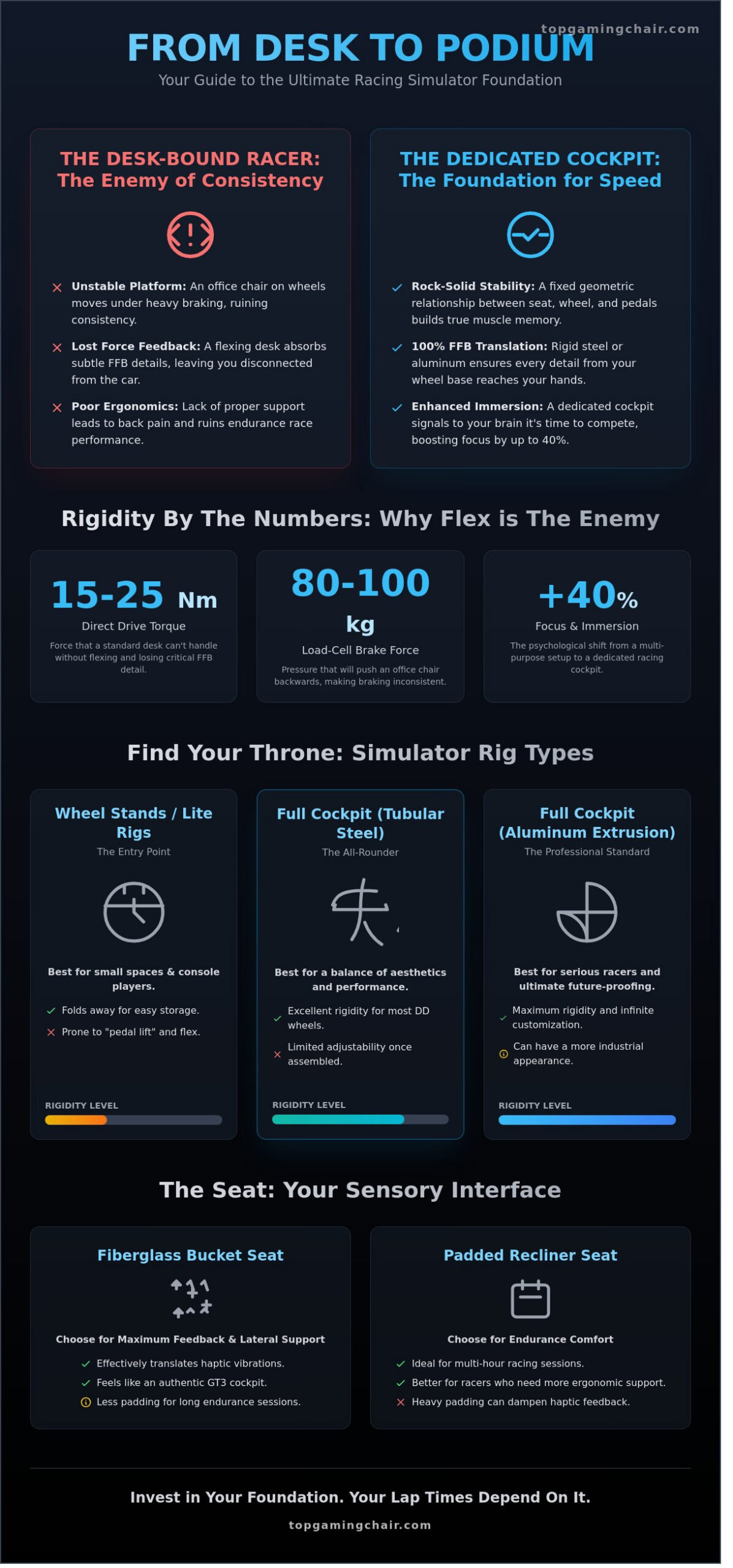
To fully grasp what is sim racing in a competitive context, you have to treat it as a physical discipline. A dedicated racing seat simulator provides a fixed geometric relationship between your shoulders, hands, and feet. This rigidity allows you to focus entirely on the apex rather than bracing your body against a swivel base. The psychological shift is immediate. Sitting in a dedicated cockpit signals to your brain that it’s time to compete, increasing focus and immersion by 40% compared to a multi-purpose workstation.
Force Feedback (FFB) translation is another critical factor. Modern direct-drive wheel bases often output 15Nm to 25Nm of torque. A standard wooden desk acts like a dampener, vibrating and flexing under the load. This absorbs the subtle road textures and tire slip data you need to drive on the limit. A steel or aluminum cockpit ensures that 100% of those signals reach your hands without being lost to structural flex.
Racing Simulator vs. Standard Gaming Chair
Even the best gaming chairs aren’t built for the rigors of load-cell braking. Professional-grade pedals often require 80kg to 100kg of force to reach maximum braking pressure. In a standard chair, this pressure causes the backrest to flex and the gas cylinder to wobble. You should upgrade to a sim rig the moment you move beyond entry-level gear. Caster wheels are the enemy of fast lap times; you need a platform that stays 100% stationary under heavy G-force simulation.
The Role of the Seat in Feedback
Your seat is more than a place to sit; it’s a sensory interface. If you plan on using “butt-kickers” or haptic transducers, the seat material matters. A fiberglass bucket seat translates high-frequency vibrations from haptic motors much more effectively than a heavily padded recliner. While a recliner is better for 6-hour endurance sessions, a fixed bucket seat offers the lateral support required to feel like you’re actually in a GT3 cockpit. Choose your racing seat simulator based on your primary racing style to ensure the best balance of comfort and tactile data.
Understanding Rig Types: From Wheel Stands to Full Motion Cockpits
Choosing the right racing seat simulator depends on your available floor space and your long-term performance goals. The industry has evolved rapidly since 2018, moving from simple desk clamps to professional-grade hardware. This shift is validated by the FIA’s commitment to sim racing through its recent official hardware partnerships. This recognition proves that your home setup is no longer just a gaming peripheral; it’s a legitimate training tool for motorsport.
Wheel Stands and Lite Rigs
Wheel stands are the entry point for racers who don’t have a dedicated room for their hobby. Models like the Next Level Racing Wheel Stand 2.0 provide a heavy-duty steel base that folds away in under 60 seconds. These are perfect for console players in small apartments who use a standard office chair. While they save space, they often suffer from “pedal lift” during heavy braking. You’ll need a way to lock your chair’s casters to prevent yourself from rolling backward when you hit the anchors at T1.
Full Simulation Cockpits
Static cockpits provide the rigidity needed for high-end direct drive wheels. You’ll generally choose between tubular steel frames or aluminum extrusion rigs. Tubular frames look like real race car chassis, but they lack adjustability. Aluminum extrusion, or 80/20, has become the current industry standard for customization. These rigs use T-slot channels that allow you to bolt on shifters, handbrakes, and monitors at any height or angle. If you’re planning to build a “throne” for long-distance endurance racing, a static 80/20 rig is the most stable foundation you can buy. You can find more details on frame durability in our comprehensive sim hardware reviews.
Motion and Haptics Integration
For the top 5% of enthusiasts, motion platforms add a layer of physical feedback that a static racing seat simulator cannot match. A 2-DOF (Degree of Freedom) system simulates pitch and roll, tilting your seat as you accelerate or corner. Advanced 3-DOF or 4-DOF setups add heave and traction loss, allowing you to feel the rear tires sliding out. These systems typically cost between $3,500 and $12,000 for home-use kits. While the price is high, the immersion gain is massive. Haptic transducers, like the ButtKicker Gamer Plus, offer a more affordable alternative by using vibrations to simulate engine RPM and gear shifts for under $300.
Wheel Stands: Best for casual play and limited space.
Static Cockpits: Essential for Direct Drive wheels (10Nm+ torque).
Aluminum Extrusion: Best for future-proofing and adding accessories.
Motion Platforms: The peak of immersion for professional-level home setups.
The Rigidity Factor: Why Flex is the Enemy of Fast Laps
Flex occurs when your racing seat simulator bends under the physical loads of driving. It usually happens in two specific areas: the wheel deck and the pedal tray. When your equipment moves, it absorbs energy that should go into your hands or feet. This movement muddies the force feedback signal. If you use a Direct Drive (DD) wheel, even 2mm of movement can mask the subtle vibrations that tell you when your front tires are losing grip. You aren’t just losing “feel”; you’re losing the data you need to react to the car’s behavior.
Rigidity is the foundation of a professional setup. Tubular steel rigs often use 1.5mm wall thickness. They look sleek, but they often oscillate under high loads. In contrast, 80/20 aluminum profiles, specifically 40x120mm or 40x160mm sizes, offer zero-flex performance. These T-slot extrusions are the industry standard for 2026 builds because they allow for millimetre-perfect adjustments without sacrificing structural integrity.
Tubular Steel: Lightweight and affordable but prone to “micro-flex” in the joints.
80/20 Aluminum: The gold standard for modularity and absolute stiffness.
Signal Loss: Every millimeter of flex is a percentage of force feedback detail lost to the frame.
The Pedal Plate Showdown
Consistency is the key to fast laps. Modern load-cell pedals require up to 100kg (220lbs) of force to reach maximum braking. If your pedal plate flexes, your brain can’t build the muscle memory needed for perfect trail-braking. Entry-level rigs often need a “stiffening kit” or DIY reinforcement to stop the plate from bowing. Without a rock-solid base, you’ll never hit the same braking point twice. A rigid plate ensures that 100% of your leg pressure translates into the sim’s telemetry.
Wheel Deck Stability
High-end bases like the Simucube 2 Pro or Fanatec DD2 output between 15Nm and 25Nm of torque. A standard bottom-mount plate often acts like a diving board, creating vertical oscillation during heavy curb strikes. Side-mounting or front-mounting the motor directly to the uprights is the superior choice for any high-end racing seat simulator. This configuration eliminates the side-to-side wobble found in cheaper setups and ensures every bit of torque reaches your palms. It transforms the experience from a “toy” feel into a professional training tool.
Buying Guide: Choosing the Right Racing Seat for Your Room and Budget
Finding the right racing seat simulator depends on your torque requirements and floor space. You aren’t just buying furniture; you’re selecting the chassis that must withstand hundreds of pounds of braking force. If your frame flexes, you lose the fine tactile details provided by your wheelbase, which directly impacts your lap times.
Budget tiers usually fall into three categories. In the $200 to $400 range, you’ll find foldable rigs and basic wheel stands. These are excellent for those with limited space, but they often suffer from “pedal lift” during heavy braking. Avoid these if you plan on using load-cell pedals that require over 60kg of pressure. Most entry-level rigs in this bracket are designed for gear-driven wheels like the Logitech G923 and struggle with the 5Nm to 8Nm of force produced by modern direct drive bases.
Stepping into the $500 to $900 mid-range brings you to the “sweet spot” of the hobby. This is where 80/20 aluminum profile rigs dominate. These frames use 40mm x 80mm or 40mm x 120mm extruded aluminum, providing a modular “throne” that doesn’t budge. This tier allows you to bolt on real automotive bucket seats or specialized sim seats that offer the rigidity needed for 10Nm to 15Nm wheelbases.
Premium setups exceeding $1,000 are built for professional-grade immersion. These rigs often feature 15mm thick steel mounting plates and are “motion ready.” If you plan to add haptic actuators or a D-BOX system in the future, you need this level of structural integrity. These rigs frequently include integrated triple monitor mounts to keep your screens perfectly aligned during high-G maneuvers.
Measuring your room is a non-negotiable step. A standard static cockpit requires a footprint of roughly 150cm by 60cm. If you opt for an integrated monitor stand, add an extra 30cm of depth for the screen overhang. Ensure you have at least 50cm of clearance on one side to climb in and out of the bucket seat comfortably.
Compatibility Checklist
Most rigs manufactured in the 2024 to 2026 cycle come pre-drilled for major brands. You should verify that the mounting plate supports the hole patterns for Logitech, Fanatec, and Thrustmaster. If you’re building your first rig, our Sim Racing Cockpit Guide for Beginners offers a deep dive into hardware pairing. Always look for adjustable seat sliders and pedal tray tilt options. These adjustments allow you to mimic the seating position of a GT3 car or a Formula 1 car depending on your preference.
Seat Comfort for Endurance Racing
Endurance races can last 4 hours or more, making breathability vital. While vinyl is easy to clean, it traps heat and causes discomfort after 45 minutes of intense driving. Fabric or Alcantara options provide significantly better airflow. Pay close attention to bolster width. A standard seat accommodates a 38cm waist, but drivers with larger frames should look for “XL” variants to avoid hip pinching during long sessions.
Top Racing Seat Simulator Recommendations for 2026
Choosing the right racing seat simulator is the difference between a shaky, toy-like experience and a professional-grade setup. For 2026, we have identified the top performers based on frame rigidity, modularity, and ergonomic support. Your rig is the foundation of your entire sim racing career; it needs to be as stable as the car you are virtually driving.
Best Overall: The Aluminum Extrusion Rig. This 160mm x 40mm profile frame remains the gold standard for long-term growth. Its modular nature allows you to bolt on keyboard trays, shifter mounts, and even motion actuators as your budget expands. It handles 25Nm of torque with zero measurable flex.
Best Budget: The Stable Lite Rig. If you are using an entry-level 5Nm or 8Nm wheel, you do not need a heavy steel beast. This rig offers a reinforced pedal plate that prevents “lifting” during heavy braking. It is a massive upgrade over a desk clamp setup for under $400.
Best for Space-Saving: The Foldable Cockpit. Perfect for apartment dwellers, this design utilizes high-tension locking hubs. It folds down in approximately 120 seconds without requiring you to remove your wheel and pedals, making it easy to tuck into a closet.
Best for Realism: The Integrated GT-Style Cockpit. This setup features a molded fiberglass bucket seat bolted directly to a powder-coated steel chassis. It mimics the exact seating geometry of a GT3 race car, providing the immersion required for competitive iRacing or Assetto Corsa Competizione sessions.
Our Testing Methodology
We do not just sit in these rigs; we push them to the physical limit. Our team uses high-torque Direct Drive bases, specifically testing for lateral flex at 20Nm of force. We also conduct endurance evaluations consisting of 4-hour continuous racing sessions. If a racing seat simulator causes lower back fatigue or “hotspots” before the 240-minute mark, it fails our comfort criteria. Stiffness is important, but comfort wins long-distance races.
Final Verdict: Which Rig Should You Buy?
To find your perfect throne, use our 3-question test. What is the maximum torque of your wheel base? Do you have a permanent 6-foot by 3-foot space available? How many hours a week will you spend in the cockpit? If you are a larger racer who finds standard bucket seats too narrow, the Titan Edge XL is a fantastic heavy-duty alternative that offers extra width without sacrificing structural support. After you select your racing seat simulator, prioritize cable management. Use velcro ties to secure your peripheral cords to the frame to prevent snagging during intense steering maneuvers.
Claim Your Throne on the Virtual Track
Building a high performance rig for 2026 requires more than just high torque wheelbases. It starts with a rock solid foundation. Eliminating flex is your primary goal because even 1mm of movement in your pedal plate can cost you tenths on the track. We’ve spent years identifying the gear that survives the pressure of competitive driving. Since 2018, our team has rigorously tested over 80 gaming and racing seats to separate the professional grade equipment from the toys. These insights come from hands-on reviews by competitive sim racers who understand that your racing seat simulator is the cockpit where every victory is earned. Whether you need a compact wheel stand or a full motion rig, choosing the right frame ensures your hardware performs at its peak. Don’t settle for a setup that wobbles when the race gets intense. It’s time to invest in a platform that supports your journey to the podium.
We provide independent, affiliate-supported research to help you build the ultimate setup. Get behind the wheel and start shaving seconds off your personal best today.
Frequently Asked Questions
Do I need a special chair for sim racing?
You don’t strictly need a dedicated seat for entry-level setups, but a specialized racing seat simulator is essential if you use high-end direct drive wheels. Standard office chairs on wheels will roll backward when you apply 50kg of pressure to a load-cell brake pedal. A dedicated rig keeps your body geometry consistent, which helps you build the muscle memory required for faster lap times.
Can I use a racing seat simulator with a desk?
Yes, you can use a wheel stand or a “half-cockpit” that connects to your existing desk chair. Brands like Next Level Racing offer the Wheel Stand 2.0 which weighs about 22kg and includes a cradle to prevent your chair from rolling away. It’s an excellent middle ground if you don’t have the 1.5 meters of floor space required for a full permanent chassis.
What is the best racing seat for a small apartment?
The Playseat Challenge X is the gold standard for small spaces because it folds flat in under 30 seconds. It weighs roughly 11.6kg and can be stored in a closet when you aren’t racing. For a more rigid but still compact option, the Next Level Racing GT Lite occupies a footprint of just 176 by 93 cm while supporting entry-level direct drive bases.
Are expensive racing simulators actually worth the money?
High-end simulators are worth the investment if you use direct drive wheels that produce over 10Nm of torque. A $1,500 aluminum extrusion rig provides zero flex, ensuring all the force feedback goes into your hands rather than vibrating through a flimsy frame. Since 2018, our team has tested 85 different seats and found that rigidity is the single biggest factor in driver consistency.
Will my Logitech G923 or Fanatec wheel fit any racing seat?
Most modern racing seat simulator setups feature universal mounting plates with pre-drilled holes for Logitech, Thrustmaster, and Fanatec hardware. The Logitech G923 uses a standard three-bolt pattern that has been the industry standard for over 10 years. If you buy a boutique direct drive base like a Simucube 2, you might need a specific front-mount bracket that usually costs around $50.
What is an 80/20 or aluminum extrusion rig?
An 80/20 rig is a cockpit built from modular T-slot aluminum profiles that allow for infinite adjustability. The name refers to the specific industrial framing dimensions, though most modern rigs use 40mm by 80mm or 40mm by 120mm profiles. These setups are the “forever rigs” of the community because you can bolt on new accessories like handbrakes or keyboard trays without drilling any holes.
Do racing simulators come with the wheel and pedals?
Most sim racing cockpits are sold as standalone frames and don’t include the electronics. You’ll typically spend $300 to $800 on the chassis alone, then purchase your wheel and pedals separately. Some “ready-to-race” bundles exist from companies like Fanatec or SimLab, but 90% of enthusiasts prefer to mix and match hardware to build their ultimate throne.
How much space do I need for a full racing cockpit?
You should set aside a dedicated area of at least 1.5 meters long and 0.6 meters wide for a standard fixed cockpit. If you’re adding triple 32-inch monitors, your width requirement jumps to nearly 1.5 meters. Always leave a 30cm buffer around the rig so you can climb in and out of the bucket seat without hitting your walls or other furniture.
Of course, after spending hours perfecting lap times in your virtual cockpit, there are times you’d rather enjoy the ride as a passenger. For a taste of professional, real-world driving luxury, services like NG Town Car Service provide a comfortable and reliable alternative, especially for those in the Seattle area.
The owner of Topgamingchair.com started writing about technology news and trends back in 2014. As an author and guest author of numerous technology magazines, he tries to transfer his experience in this area to the readers in an easily understandable and helpful way.