That familiar, nagging ache that creeps into your lower back two hours into a marathon session. The one that turns a victory screen into a reminder that you’ll be stiff for the rest of the night. You know you need an upgrade, but the search for the best gaming chair for back pain can feel like a quest in itself, filled with confusing jargon and empty promises. A bad choice isn’t just a waste of money-it’s a direct hit to your health and your in-game focus, turning your command center into a source of discomfort.
That’s where we come in. Our team has rigorously tested and analyzed the top contenders for 2026 to create the ultimate buyer’s guide. In this in-depth breakdown, we cut through the marketing noise to show you exactly which ergonomic features-from dynamic lumbar support to multi-tilt mechanisms-actually provide lasting relief and promote better posture. We’ll equip you with the expert knowledge to invest confidently in a chair that serves as a true gaming throne, allowing you to focus on the win, not the wince. Stop gaming in pain and start playing in peak comfort and performance.
Key Takeaways
Understand the science behind why your back hurts during long gaming sessions to effectively combat the root cause of the pain.
Discover the five critical ergonomic features that separate a truly supportive gaming throne from one that just looks the part.
Get our in-depth verdict on the top models that earned their spot as the best gaming chair for back pain after hours of rigorous, hands-on testing.
A great chair is only half the battle; follow our expert setup guide to perfectly adjust your chair and maximize pain relief from day one.
Why Your Back Hurts: The Science Behind Gaming and Back Pain
That nagging lower back pain after a long session isn’t just a sign of a hard-fought battle; it’s a red flag from your body. The throne upon which you game is often the direct cause. Prolonged sitting in a static position puts immense stress on your spine, muscles, and discs. Your body is designed for movement, but when you’re locked into an intense match, you’re forcing it into an unnatural, sustained posture that can lead to chronic pain and long-term damage.
The Dangers of Poor Gaming Posture
When you’re focused, it’s easy to fall into the dreaded “gamer slouch”-a C-shaped curve in your spine with your head pushed forward. This posture might feel natural in the heat of the moment, but it concentrates a massive amount of pressure on your lumbar discs. Over time, this compression can lead to serious issues, manifesting as pain that radiates through your entire upper body. This single bad habit is a primary cause of:
Chronic Lower Back Pain: From the constant strain on your lumbar region.
Neck and Shoulder Strain: Caused by your head leaning forward, away from its center of gravity.
Sciatic Nerve Pain: Pressure on the discs can irritate the sciatic nerve, sending pain down your legs.
How Standard Chairs Exacerbate the Problem
Grabbing any old office chair or a cheap gaming knock-off is a recipe for disaster. These chairs often ignore fundamental ergonomic principles designed for human well-being. They typically feature a one-size-fits-all design with fixed lumbar support (if any), a flat seat pan that creates painful pressure points on your sit bones, and non-adjustable armrests that force you to shrug your shoulders, leading to upper back tension. They simply aren’t built for the marathon sessions that define modern gaming.
This brings us to the great debate: gaming chair vs. office chair. While a high-end ergonomic office chair is a fantastic tool for task-based work, the best gaming chair for back pain is engineered specifically for the dynamic postures of gaming. It supports you during intense, forward-leaning focus and relaxed, reclined cutscenes. It’s not just about sitting; it’s about providing a supportive, adaptable foundation for every moment of your gaming experience, ensuring your spine is protected no matter the in-game situation.
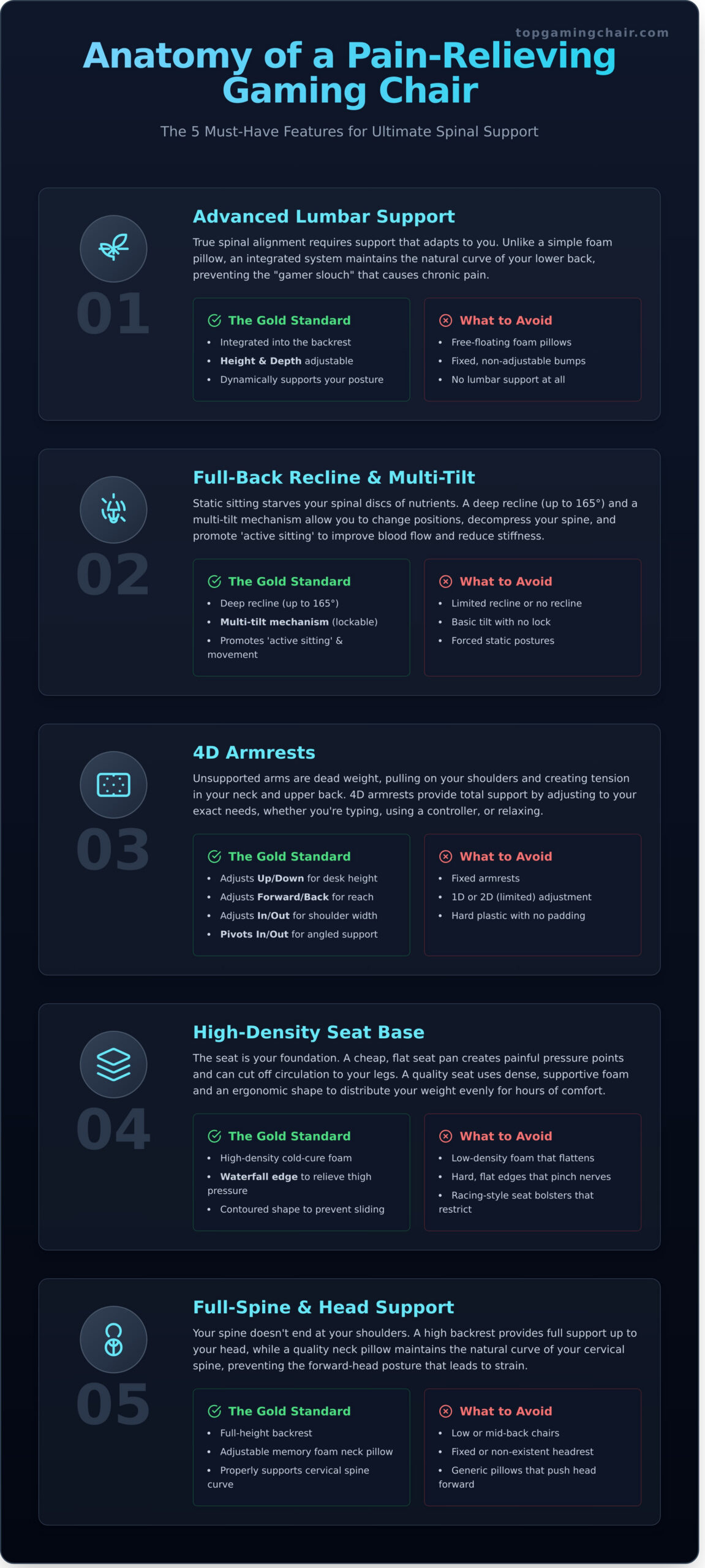
The Anatomy of a Pain-Relieving Gaming Chair: 5 Must-Have Features
Searching for the best gaming chair for back pain isn’t about flashy logos or racing stripes; it’s about a deep understanding of ergonomics. A chair that fails to support your spine correctly isn’t just uncomfortable-it’s actively contributing to long-term pain. To help you make an informed decision, we’ve created the ultimate buyer’s checklist. These are the non-negotiable features that separate a temporary seat from a true ergonomic throne designed for spinal health.
1. Advanced Lumbar Support: Beyond the Pillow
That free-floating foam pillow included with many chairs is a flimsy patch, not a solution. True spinal alignment comes from integrated, dynamic lumbar support. The gold standard is a system built directly into the chair’s backrest that allows for both height and depth adjustments. This lets you position the support precisely into the curve of your lower back. According to ergonomic seating advice from the NHS, maintaining this natural spinal curve is critical for preventing strain. Advanced systems, like Secretlab’s L-ADAPT™, are a prime example, offering a custom fit that a simple pillow can never replicate.
2. Full-Back Recline & Multi-Tilt Mechanism
Your body was not designed to stay in one static position for hours. A generous full-back recline (ideally up to 165 degrees) is essential for taking pressure off your spinal discs during breaks. Even more important is a multi-tilt mechanism. This feature allows you to rock back and forth or lock the chair at a slight angle, promoting ‘active sitting.’ These subtle movements engage your core muscles and improve blood flow, fighting the stiffness that leads to chronic aches. A high backrest is crucial here, ensuring your entire spine is supported from your pelvis to your neck.
3. 4D Armrests: Your First Line of Defense
Unsupported arms are dead weight, pulling down on your shoulders and straining the trapezius muscles in your upper back and neck. 4D armrests are your first line of defense against this fatigue. They provide the ultimate level of customization, allowing you to adjust them in four distinct directions:
Up/Down: To match your desk height.
Forward/Back: To support your forearms when typing or relaxing.
In/Out: To match your shoulder width.
Pivot Angle: To support your arms when using a controller.
By perfectly positioning the armrests, you take the load off your upper body, making it effortless to maintain a healthy, upright posture.
4. The Seat Base: Foundation of Comfort
The seat is the foundation for your entire posture. The best gaming chair for back pain will always feature a firm, high-density cold-cure foam base. Unlike softer foams that sag and ‘bottom out’ over time, cold-cure foam provides resilient, long-lasting support. Look for a ‘waterfall’ seat edge, which curves downward to prevent the edge from digging into the back of your thighs and restricting blood flow. Finally, choosing the right size is paramount; a seat that is too deep or too narrow will create pressure points and force you into an unhealthy slouch.
Our Rigorously Tested Picks: Top 4 Gaming Chairs for Back Pain
We don’t just recommend chairs based on spec sheets. Our team has logged hundreds of hours in these gaming thrones, putting each one through a gauntlet of long gaming sessions, workdays, and ergonomic assessments. This hands-on, in-depth process allows us to cut through the marketing hype and identify which features genuinely deliver on the promise of pain relief. Below are the champions that emerged from our rigorous testing, each representing the pinnacle of support for different needs and budgets.
Secretlab TITAN Evo: Best Overall for Back Pain
The Secretlab TITAN Evo stands as our top recommendation because it offers the most complete and adaptable back support system on the market. Its brilliance lies in the 4-way L-ADAPT™ integrated lumbar support, which moves up, down, in, and out to perfectly match the curve of your spine. Unlike static pillows, this dynamic system provides consistent support as you shift positions. Combined with a medium-firm cold-cure foam base that encourages an upright posture and its availability in three distinct sizes (S, R, XL), the TITAN Evo provides a tailored ergonomic fit that makes it the best gaming chair for back pain for the vast majority of users.
Pros: Highly customizable lumbar support, multiple sizes for a perfect fit, premium build quality.
Cons: The seat is intentionally firm, which may not suit those who prefer a softer chair.
Herman Miller x Logitech Embody: Best Premium Ergonomic Choice
For those who view their chair as a long-term investment in health, the Herman Miller Embody is in a class of its own. It swaps traditional foam for a dynamic matrix of 150 pixels that flex and conform to your body’s slightest movements. This “Pixelated Support” ensures pressure is always evenly distributed, promoting blood flow and eliminating the pressure points that cause pain and numbness. It’s a scientifically engineered throne designed for one thing: to keep you properly supported without you ever having to think about it. The price is significant, but so is the level of ergonomic innovation.
Cons: A top-tier price tag that puts it out of reach for many.
AndaSeat Kaiser 3: Best for Aggressive Lumbar Support
If you find that most built-in lumbar systems are too subtle, the AndaSeat Kaiser 3 is the powerhouse you need. Its 4-way adaptive lumbar support is noticeably more pronounced and firm than its competitors, providing aggressive reinforcement right where it’s needed most. This is ideal for gamers who require a constant, forceful reminder to maintain their lumbar curve. Its generous sizing and robust steel frame make it a fantastic choice for larger users seeking a fortress of support that won’t buckle under pressure.
Pros: Exceptionally firm and prominent lumbar support, spacious seat base, magnetic pillow system.
Cons: The lumbar support can feel too intense for some users.
Noblechairs HERO: Best for Upper Back and Shoulder Support
Back pain isn’t always confined to the lower back. The Noblechairs HERO addresses this with a wider, taller backrest specifically designed to provide ample support for the upper back and shoulders, preventing the all-too-common forward slump. While its integrated lumbar support is adjusted via a simpler dial, it offers consistent and effective reinforcement. The HERO’s dense, cold-foam padding is exceptionally firm, making it impossible to slouch and forcing you into a healthier posture during marathon sessions. Its understated, professional design also means it won’t look out of place in a home office.
Pros: Superior support for the entire spinal column, including shoulders, firm padding encourages good posture, sophisticated aesthetic.
Cons: Lumbar adjustment is less precise than 4-way systems.
How to Set Up Your Chair to Maximize Back Pain Relief
You’ve invested in one of the top contenders, but securing the best gaming chair for back pain is only half the battle. An improperly adjusted chair can negate even the most advanced ergonomic features. Think of this setup process as calibrating your throne for victory-and for a pain-free spine. Follow these in-depth steps to unlock the full potential of your chair and ensure you’re supported correctly for those marathon gaming sessions.
Achieving the 90-90-90 Rule
This ergonomic principle is the foundation for a healthy sitting posture. It ensures your body weight is distributed evenly, reducing strain on your joints and spine. It’s your first and most critical adjustment.
Seat Height: Adjust your chair so your feet are planted flat on the floor. Your thighs should be parallel to the ground, forming a 90-degree angle at your knees. If your feet dangle, you’re too high; if your knees are above your hips, you’re too low.
Hip Angle: Your hips should also be at a 90-degree angle relative to your torso. For even better spinal decompression, experts recommend a slightly open angle. Use the recline function to set your backrest between 95 and 110 degrees for optimal comfort.
Dialing in Your Lumbar and Armrest Positions
With your foundation set, it’s time to fine-tune the support systems. The lumbar pillow and armrests are not accessories; they are essential tools for preventing slouching and upper body tension.
Position the lumbar support so it fits perfectly into the natural inward curve of your lower back (your lumbar spine). It should feel supportive, not like it’s pushing you off the chair. Next, adjust your armrests so they are level with your desk. Your elbows should rest comfortably at a 90-degree angle, allowing your shoulders to relax completely. This simple tweak prevents the unconscious shrugging that leads to neck and shoulder pain.
Creating an Ergonomic Ecosystem
Remember, your chair is the command center of a complete ergonomic ecosystem. To truly defeat back pain, your entire setup must work in harmony. Ensure the top of your monitor is at or just below eye level to keep your neck in a neutral position. Your keyboard and mouse should be close enough that you can use them without reaching or leaning forward. Combining a perfectly calibrated chair with a thoughtful desk setup transforms your gaming rig into a fortress of comfort and support. For more guides and in-depth reviews, explore everything we offer at TopGamingChair.com.
Claim Your Throne: The Final Verdict on Pain-Free Gaming
Your marathon gaming sessions shouldn’t end in chronic discomfort. As we’ve explored, the right ergonomic features-like dynamic lumbar support, full adjustability, and high-density foam-are not just luxuries; they are essential tools for protecting your spine. Investing in a supportive chair and setting it up correctly is a long-term commitment to both your health and your in-game performance, ensuring you can stay focused on the win.
While our top 5 picks represent the pinnacle of ergonomic design, finding the best gaming chair for back pain is a personal journey. That’s why our work doesn’t stop here. Since 2018, our expert team of gamers and writers has put over 80 chairs through hands-on, rigorous testing to help you make the most informed decision for your battle station.
Don’t let discomfort dictate your limits. Equip yourself with the right support, reclaim your comfort, and get back to focusing on what truly matters: securing that next victory. Game on, pain-free.
Frequently Asked Questions
Are bucket-style racing seats good for back pain?
While they look aggressive, traditional bucket-style seats are often not the best choice for back pain. Their pronounced side bolsters are designed to secure a driver during high-speed turns, not for long-term sitting comfort. These “wings” can restrict your movement and push your shoulders forward, encouraging a hunched posture. For extended gaming sessions, a chair with a flatter backrest and dedicated, adjustable lumbar support will offer far superior ergonomic relief.
Is a firm or soft seat cushion better for sciatica and back pain?
For both sciatica and general back pain, a medium-firm seat base is the undisputed champion. A cushion that’s too soft allows your hips to sink, misaligning your spine and straining your lower back. Conversely, a rock-hard seat creates intense pressure points on your sit bones and tailbone. The ultimate material is high-density cold-cure foam, which delivers the perfect balance of supportive resistance and contouring comfort for marathon gaming sessions.
How long does it take to get used to an ergonomic gaming chair?
The adjustment period for a new ergonomic chair typically ranges from a few days to two weeks. If your previous chair encouraged poor posture, sitting in a correctly aligned position might feel unnatural or even slightly uncomfortable at first. This is your body and muscles adapting to proper support. Be patient during this break-in period; the long-term comfort and health benefits are a massive payoff for your gaming endurance.
Can a gaming chair permanently fix my bad posture?
A gaming chair is a powerful tool, but it is not a magic cure for bad posture. It’s designed to promote and support correct spinal alignment *while you are sitting in it*. Think of it as your throne for building better habits. True, permanent posture correction requires a conscious effort that includes using your chair correctly, taking regular breaks to stand and stretch, and strengthening your core and back muscles outside of your gaming sessions. For gamers exploring additional wellness options to manage discomfort, you can visit CBD Health Collection.
If your pain persists even after making these changes, it might be a sign of an underlying issue that requires professional attention. For those in the UK, finding the right specialist can be simplified by using online directories; for example, Guide2Care provides a comprehensive list of various care providers.
What’s more important for back pain: the lumbar support or the recline function?
For actively combating back pain during gameplay, the lumbar support is more critical. Its primary function is to maintain the natural inward curve of your lower spine, preventing you from slouching and reducing spinal disc pressure. The recline function is also essential, but it serves a different purpose: it allows you to shift your body weight and decompress your spine during breaks. For constant, active support, a great lumbar system is your first line of defense.
Is it worth spending over $500 on a gaming chair for back pain?
Absolutely. When you’re serious about finding the best gaming chair for back pain, investing over $500 is often a necessary step. This price point unlocks the premium build quality and advanced ergonomic features that make a real difference, such as 4D integrated lumbar systems, higher-density foam that resists sagging, and robust multi-year warranties. This isn’t just a chair; it’s a long-term investment in your health, comfort, and gaming performance.
The owner of Topgamingchair.com started writing about technology news and trends back in 2014. As an author and guest author of numerous technology magazines, he tries to transfer his experience in this area to the readers in an easily understandable and helpful way.