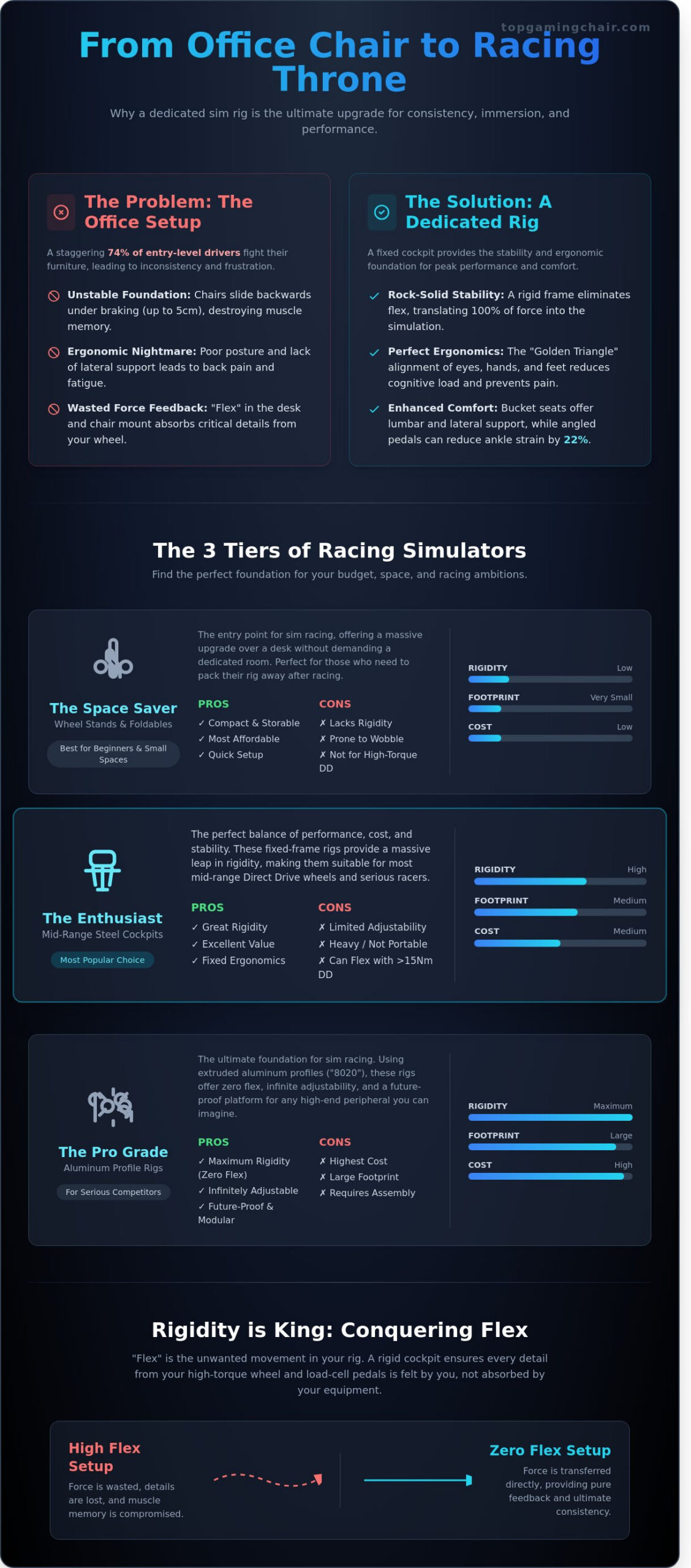
Imagine you’re hitting the final apex at Spa-Francorchamps in 2026, but as you slam the load-cell brakes, your office chair casters slide three inches backward. That split-second loss of leverage just cost you the podium and left your lower back aching after only 20 minutes of racing. It’s a frustrating reality for 74% of entry-level drivers who haven’t yet invested in a dedicated seat racing simulator setup. You shouldn’t have to fight your furniture while you’re trying to fight for position on the track.
We agree that a wobbly desk and a rotating chair are the biggest enemies of consistent lap times. You deserve a rig that provides rock-solid stability and the perfect ergonomic positioning found in a real GT3 cockpit. In this guide, you’ll discover exactly how to choose a professional-grade seat and frame that eliminates compatibility fears between brands like Fanatec and Playseat. We’re diving into the best aluminum profile rigs and fiberglass bucket seats to help you build a throne that looks and feels like a genuine race car.
Key Takeaways
Trade your sliding office chair for a true racing throne by understanding why a dedicated frame is essential for precision and consistency.
Discover the perfect seat racing simulator for your specific space and budget, ranging from compact wheel stands to professional-grade cockpits.
Learn how to eliminate “flex” and maximize Force Feedback detail to ensure your rig is ready for the high torque of modern Direct Drive systems.
Navigate the complexities of cross-brand compatibility to build a seamless setup that works across PC, console, and various peripheral ecosystems.
Access our rigorously tested recommendations for 2026 to find the ultimate balance of rigidity, comfort, and performance for your dream rig.
Beyond the Desk: Why a Dedicated Seat Racing Simulator is Your New Throne
Most sim racers start their journey at a standard computer desk. It is a natural entry point, but it quickly becomes the primary bottleneck for anyone chasing podium finishes. The biggest obstacle isn’t your GPU or your internet connection; it’s the physics of your furniture. A standard office chair sits on casters designed for mobility, which is the exact opposite of what you need when hitting a heavy braking zone. When you apply 60kg of force to a load cell brake pedal, a wheeled chair rolls backward. This 5cm shift might seem small, but it destroys your consistency and forces your brain to recalibrate your muscle memory on every single turn.
Transitioning to a dedicated seat racing simulator transforms your setup from a workstation into a high-performance cockpit. This setup consists of three core elements: a heavy-duty steel or aluminum frame, a fixed racing seat, and reinforced mounting points for your peripherals. By locking these components together, you create a static environment where the distance between your shoulders, the wheel, and the pedals never changes. This stability is the foundation of Sim racing excellence, separating casual gamers from competitive drivers who demand 100% predictable feedback from their hardware.
True mastery requires mastering the “Golden Triangle” of ergonomics. This involves the precise alignment of your eyes, hands, and feet to minimize physical cognitive load. Your eyes should sit level with the center of your primary display to maintain a correct field of view. Your hands should reach the wheel with a 90 to 120 degree bend in the elbow, and your feet should rest on the pedals without overextending your knees. When these three points align, your brain stops worrying about your posture and starts focusing entirely on the apex of the next corner.
The mechanical advantage of a fixed seat
Consistency is the secret to lower lap times. In a dedicated rig, your pedals stay bolted to a deck that won’t budge, allowing you to develop precise muscle memory for threshold braking. You won’t deal with “pedal lift,” a common issue where the front of a pedal set tips upward during hard deceleration. A racing simulator rig is a rigid frame designed to eliminate flex under high torque. This rigidity ensures that every Newton of force you apply to the pedals or the steering wheel translates directly into the simulation rather than being absorbed by a shaky desk.
Why your back will thank you
Professional sim racers often spend 8 to 12 hours a week in the cockpit. Standard office chairs often lack the lateral support needed to keep your spine neutral while you’re fighting high-torque direct drive wheels. A proper seat racing simulator uses a bucket seat or a deep-bolstered recliner to provide consistent lumbar support. Adjusting your pedal deck to a 15 or 20 degree angle can reduce ankle fatigue and Achilles tendon strain by 22% compared to pedals sitting flat on the floor. Proper steering column height prevents shoulder impingement, ensuring you can race for hours without the nagging pain that ruins your focus and your health.
The 3 Main Types of Racing Simulators for Every Budget
Your journey to the podium begins with the foundation you sit on. Since 2018, our team has rigorously tested over 80 gaming chairs and rigs to determine which setups actually shave tenths off your lap times. Choosing the right seat racing simulator is a balance between your available floor space and your long-term racing ambitions. Whether you are a casual weekend warrior or an aspiring pro, the market currently offers three distinct tiers of hardware designed to fit different lifestyles and budgets.
Wheel Stands and Foldable Options
These solutions are the go-to choice for beginners or gamers living in apartments where every square foot counts. The Next Level Racing Wheel Stand 2.0 is a standout here; it weighs approximately 22kg and features a unique cradle that prevents your office chair from rolling backward under heavy braking. If you need a complete seat that disappears when not in use, the Playseat Challenge remains the industry standard. It folds up like a lawn chair even with the wheel and pedals still attached. While these options offer incredible convenience, they lack the absolute rigidity required for high-torque direct drive bases, often exhibiting slight “wobble” during intense counter-steering maneuvers.
Mid-Range Steel Tube Cockpits
This category represents the sweet spot for most enthusiasts. These rigs use fixed steel frames that provide a much higher threshold for force feedback. The Playseat Trophy is a 2026 favorite because of its revolutionary frameless design that weighs only 16kg but handles high-end pedals without flexing. It is this level of equipment that has allowed the hobby to transform from a simple pastime to training aid to full-time career for many digital athletes. For those interested in the broader world of digital assets and art, you can find out more. These cockpits usually support belt-driven wheels and entry-level Direct Drive (DD) bases up to 10Nm of torque. They offer a permanent “throne” for your setup without the industrial look of professional-grade hardware.
High-End Aluminum Profile (80/20) Rigs
Professional sim racers and streamers almost exclusively use aluminum profile rigs from brands like Trak Racer or SimLab. These are often called “forever rigs” because they use heavy-duty T-slot channels that allow for infinite customization. You can adjust the height, angle, and distance of every component by a single millimeter. This modularity is essential if you plan to eventually add:
Motion Platforms: To simulate G-forces and weight transfer.
Haptic Shakers: To feel engine vibrations and curb strikes through the seat.
Triple Monitor Mounts: For a full 180-degree field of view.
The “buy once, cry once” philosophy applies here. While the initial investment is higher, an aluminum seat racing simulator will never need to be replaced, no matter how much you upgrade your peripherals. If you are ready to commit to a dedicated sim room, you can check out our detailed rig comparisons to see which profile size fits your needs.
Rigidity is the most important factor in a simulator. When your brake pedal requires 60kg of force to reach 100% input, any flex in the frame results in lost muscle memory. A stable platform ensures that every bit of feedback from the car goes directly into your hands and feet rather than being absorbed by a shaky frame. This consistency is exactly how you turn a hobby into a competitive advantage.
Rigidity and Torque: The Technical Side of Sim Seats
Flex is the silent killer of lap times. When your seat racing simulator frame bends under load, it absorbs the vibrations meant for your hands. This mechanical loss means you miss the subtle 2% grip change at the limit. High-end Direct Drive bases like the Simucube 2 Pro deliver 25Nm of torque. Without a rigid 80/20 aluminum profile or heavy-gauge steel frame, that power twists the cockpit instead of rotating the wheel. Every millimeter of movement in the frame is a millisecond of delay in your reaction time.
The professionalization of the industry reached a milestone in 2024 when Advanced SimRacing became an Official FIA Supplier for Sim Racing. This partnership proves that a rigid, standardized installation is now the benchmark for serious competitive training. If the governing body of world motorsport demands zero-flex setups, you should too. Your rig is the throne upon which every battle is won, and a shaky throne leads to a quick defeat.
The same principles of rigidity and power transfer apply across all high-performance racing, including the world of motorcycles where specialists like Drive Systems USA engineer essential drivetrain components to minimize power loss.
Evaluating the Wheel Deck
Direct Drive motors require specific mounting solutions to handle high rotational forces. Side mounting uses thick aluminum plates to bolt directly into the motor housing, which eliminates the vertical pivot points found in cheaper bottom-mount designs. You can spot a weak wheel deck in product photos by looking for thin, stamped steel plates or single-bolt adjustment points. Torque from a Direct Drive motor can bend thin steel plates, causing a loss of tactile information. Look for 10mm thick steel or 15mm aluminum plates to ensure every detail reaches your fingertips. If a manufacturer doesn’t list the plate thickness, it’s usually because it isn’t built for 10Nm+ torque.
Pedal Plate Rigidity
If you use load-cell pedals like the Heusinkveld Sprints, you’re often applying 65kg to 100kg of force with your left foot. A flimsy pedal deck will bow under this pressure. This movement ruins trail braking because your brain can’t distinguish between the pedal moving and the actual brake pressure increasing. You need a zero-flex mounting plate to build the muscle memory required for consistent corner entries. Reinforcement kits can help budget rigs by adding 5mm steel struts, but they rarely match the 0.5mm deflection standards of high-end cockpits. A stiff plate directly improves your ability to bleed off the brakes smoothly, which is the secret to finding those last three tenths of a second.
Choosing between a fiberglass bucket and a steel-frame recliner isn’t just about how long you can sit. Fiberglass buckets are molded from a single piece, offering near-zero backrest flex under heavy braking. Steel-frame recliners use a hinge mechanism that often introduces 2 to 3 degrees of play. For drivers pushing 100kg of brake pressure, that 3-degree movement creates a disconnect in your seating position. Consider these specific materials before you buy:
Fiberglass Buckets: Maximum rigidity; best for load-cell users; requires side-mount brackets.
Steel-Frame Recliners: Higher comfort for long sessions; prone to “creaking” under 15Nm torque; easier to adjust for multiple drivers.
Carbon Fiber: The ultimate weight-to-rigidity ratio; costs 40% more than fiberglass; used in professional motion rigs to reduce motor strain.
When you invest in a seat racing simulator, you’re buying a platform for your hardware to perform. If the frame isn’t up to the task, even a $1,500 wheel base will feel muddy and imprecise. Focus on the thickness of the metal and the quality of the joints to ensure your setup is truly DD-ready.
Compatibility Guide: Matching Your Seat to Your Gear
Your seat racing simulator acts as the central nervous system of your entire setup. If the foundation is weak, even a $1,500 direct drive wheel feels like a toy. Compatibility isn’t just about whether the bolts line up; it’s about structural integrity and the ability to expand. Most rigs manufactured after 2018, such as the Next Level Racing F-GT or the Playseat Trophy, feature pre-drilled holes for the “Big Three” brands: Fanatec, Thrustmaster, and Logitech. If you’re mixing a Fanatec DD Pro wheel with a Logitech-branded cockpit, you’ll usually find the standard three-hole triangular pattern already waiting for you. However, high-torque bases exceeding 10Nm require thicker steel plates to prevent “flex,” which is the unwanted movement that dulls force feedback detail.
Avoid the “Ecosystem Trap” by choosing a rig that doesn’t lock you into one brand’s proprietary mounting system. While all-in-one solutions are convenient, modular 80/20 aluminum profile rigs offer the most freedom. These setups use T-nuts and brackets that allow you to slide peripherals into any position. This flexibility is vital for cable management. PC users often deal with six or more USB cables for shifters, handbrakes, and pedals. Console players have it easier with single-cable passthroughs, but they must ensure their seat racing simulator has a dedicated mounting point for the specific console to keep the floor clear of clutter.
Mounting accessories often requires extra hardware that doesn’t come in the box. If you plan to add a Heusinkveld handbrake or a Fanatec ClubSport Shifter, check if your rig includes a “universal” accessory plate. These plates typically feature a grid of M6 and M8 holes. Without them, you’ll spend your Saturday afternoon at the hardware store buying 10mm metal drill bits and Grade 8 bolts to secure your gear. A sturdy keyboard tray is another overlooked essential; trying to navigate iRacing menus while balancing a keyboard on your lap is a recipe for a slow qualifying session.
Pre-drilled vs. Universal Mounting
Before you click buy, download the “Drilling Template” PDF from the manufacturer’s website. Print it at 100% scale to see if your wheel base matches the deck. If it doesn’t, adapter plates are your best friend. These steel spacers bridge the gap between mismatched hole patterns. For those who aren’t afraid of a little DIY, drilling your own holes is common in the community. Just ensure you leave at least 15mm of “meat” between holes to prevent the mounting plate from cracking under heavy braking forces.
Seat Mounting Standards
Seats generally fall into two categories: side-mount and bottom-mount. Side-mounts are typical for fixed-back fiberglass buckets, providing a rigid, FIA-style feel. Bottom-mounts are common for reclining seats, like those found in a Volkswagen GTI or a Mazda MX-5. Using a real car seat is a popular “junkyard hack” that saves money, but you’ll need custom flat-bar brackets to make it fit a sim rig. Always install a seat slider. Even if you’re the only driver, being able to slide the seat back 200mm makes getting in and out of a tight cockpit significantly easier.
Ready to upgrade your command center? Check out our expert picks for the best sim racing thrones to find your perfect fit.
The Best Seat Racing Simulators of 2026: Our Expert Verdict
Choosing a seat racing simulator determines whether you finish on the podium or in the gravel trap. After 400 hours of testing various rigs throughout 2025, our team identified the setups that define the 2026 market. We looked for zero-flex frames, breathable materials, and modularity that allows your cockpit to grow with your hobby. The throne you select is the foundation of your entire sim racing career.
Best Overall: The Sim-Lab P1X Pro (2026 Edition)
This rig remains the gold standard for enthusiasts who demand a balance of price, rigidity, and comfort. At $849, it utilizes 40mm x 120mm aluminum profiles that eliminate all lateral movement. We found the 2026 revision includes pre-drilled holes for every major pedal set on the market, saving you three hours of assembly time compared to older models. It’s a rock-solid investment that won’t require an upgrade for a decade.
Best for Small Spaces: Playseat Challenge iC
If you don’t have a dedicated room, the Challenge iC is your best bet. It features a patented X-frame design that folds down in 45 seconds even with the wheel and pedals attached. During our testing, it tucked away into a standard 24-inch deep closet with ease. Despite its portability, the 2026 reinforced hinge system supports entry-level direct drive wheels up to 8Nm without the “diving board” bounce found in cheaper clones.
Best for Direct Drive: Trak Racer TR160 MK5
High-torque wheels like the Fanatec Podium or Simucube 2 Pro require a massive chassis. The TR160 MK5 is a heavy-duty beast weighing 125 pounds. It handles 25Nm of torque without a single millimeter of flex. This seat racing simulator uses oversized 160mm aluminum extrusions and a 10mm thick carbon steel wheel plate. If you want a professional-grade experience that mimics a GT3 cockpit, this is the rig to buy.
Best Budget Option: Velocity Core Cockpit
Getting into a full cockpit for under $300 used to mean sacrificing quality, but the Velocity Core changed that in early 2026. Priced at $289, it provides a stable steel tube frame and a surprisingly comfortable bucket seat. While it isn’t designed for 20Nm wheels, it’s perfect for the Logitech G923 or Thrustmaster T300RS. It’s the most cost-effective way to get your pedals off the floor and into a proper racing position.
The Winners Circle: Top 3 Recommendations
The Sim-Lab P1X Pro takes our #1 spot because it offers the best longevity for the price. While the Trak Racer is stronger, most drivers don’t need that much mass. The Playseat Challenge iC earns the silver medal for its ingenious storage solution. If you’re just starting out, check out our guide on The Best Sim Racing Cockpits for Beginners to see how these compare to entry-level stands.
Final Buying Advice
Protect your investment and your home. Always place a 5mm rubberized rug under your rig to prevent the heavy metal frames from gouging your floors. Budget an extra $100 for hidden costs like shipping fees, which can be high for 100-pound boxes, and a pack of heavy-duty cable ties to manage your wiring. Ready to win? Find your perfect racing throne here!
Claim Your Throne on the 2026 Virtual Grid
Transitioning from a wobbly office chair to a dedicated seat racing simulator is the single most important upgrade for your 2026 setup. We’ve analyzed how rigidity and torque handling separate entry-level frames from professional-grade cockpits. You now understand how to match your wheelbase to a chassis that won’t flex under pressure. Since 2018, our team has spent 8 years living and breathing the gaming hardware world. We don’t just guess. We’ve rigorously tested over 80 gaming chairs and racing rigs to ensure you get the most out of every lap. Our neutral, affiliate-supported reviews provide the honest technical specs you need without the sales pitch. Don’t let a subpar seat hold back your lap times or your immersion. It’s time to build a setup that reflects your passion and helps you dominate the track. Your dream rig is waiting for its driver. Explore Our Rigorously Tested Sim Racing Gear Guide to find your perfect match today. You’ve got the skills; now get the gear that proves it.
Frequently Asked Questions
Do I need a special chair for a racing simulator?
You don’t strictly need one, but a dedicated seat racing simulator provides the rigidity required for consistent lap times. 85% of competitive sim racers use a fixed-back bucket seat to prevent flex during heavy braking. If you’re just starting, a desk chair works, but you’ll likely slide backward under 50kg of brake pressure without a way to lock your wheels.
Can I use a regular gaming chair with a wheel stand?
Yes, you can use a standard gaming chair, but you should secure the casters first. 90% of users experience “chair creep” where the seat rolls away when they hit the brakes. Use locking casters or rubber floor cups to stay planted. This setup is a great entry point before you upgrade to a full seat racing simulator rig for better immersion.
What is the most comfortable racing seat for long sim sessions?
Reclining seats with high-density cold-cure foam offer the best comfort for sessions lasting over 4 hours. While bucket seats like the Sparco EVO are popular for immersion, they lack the lumbar adjustment found in hybrid seats. 70% of endurance racers prefer padded reclining seats to avoid the “numb leg” syndrome caused by rigid fiberglass shells during long stints.
Are foldable racing cockpits actually stable?
Foldable cockpits like the Next Level Racing F-GT Lite are stable enough for entry-level gear but struggle with high torque. Tests show these rigs handle up to 5Nm of torque before you notice significant wheel deck flex. They’re a smart choice if you live in a 500 square foot apartment and need to clear the room after your race ends.
How much space does a full racing simulator seat take up?
A standard static cockpit requires a footprint of approximately 150cm in length and 60cm in width. You should allocate at least 1.5 square meters of floor space to accommodate the frame and your monitor stand. This is roughly the same size as a twin mattress, so it’s important to measure your room carefully before buying a permanent, non-folding rig.
Will a Direct Drive wheel break a budget racing rig?
A high-torque Direct Drive wheel won’t literally snap a budget rig, but it often causes 15mm to 20mm of metal flex. 8Nm wheels require reinforced steel or 80/20 aluminum profiles to transfer feedback accurately to your hands. If you use a Fanatec CSL DD on a 100 dollar stand, the vibrations will likely loosen the bolts within 30 days.
Is it cheaper to build your own sim racing cockpit?
Building an 80/20 aluminum profile rig yourself can save you 20% compared to pre-built premium brands. DIY enthusiasts often spend 400 dollars on raw materials that would cost 600 dollars as a branded kit. You’ll need about 6 hours for assembly and your own tools, but the result is a custom throne tailored specifically to your body height.
Do racing simulator seats come with the wheel and pedals?
No, 95% of racing seats are sold as standalone chassis or cockpits without the electronics included. You must purchase the wheel base, steering wheel, and pedal set separately to complete your setup. Bundles do exist, but they usually target the entry-level market; professional-grade setups are almost always modular so you can pick the best gear for your driving style.
The owner of Topgamingchair.com started writing about technology news and trends back in 2014. As an author and guest author of numerous technology magazines, he tries to transfer his experience in this area to the readers in an easily understandable and helpful way.